Multi-category sourcing support can simplify coordination, but only if responsibilities and category capabilities are clear. Compare providers by the products they have handled, supplier qualification methods, technical review, sample and inspection processes, cost transparency, communication, and escalation. Then test those claims against a small, representative work package. One coordinator may improve visibility, while specialist suppliers or consultants may still be needed for regulated, engineered, or high-risk goods.
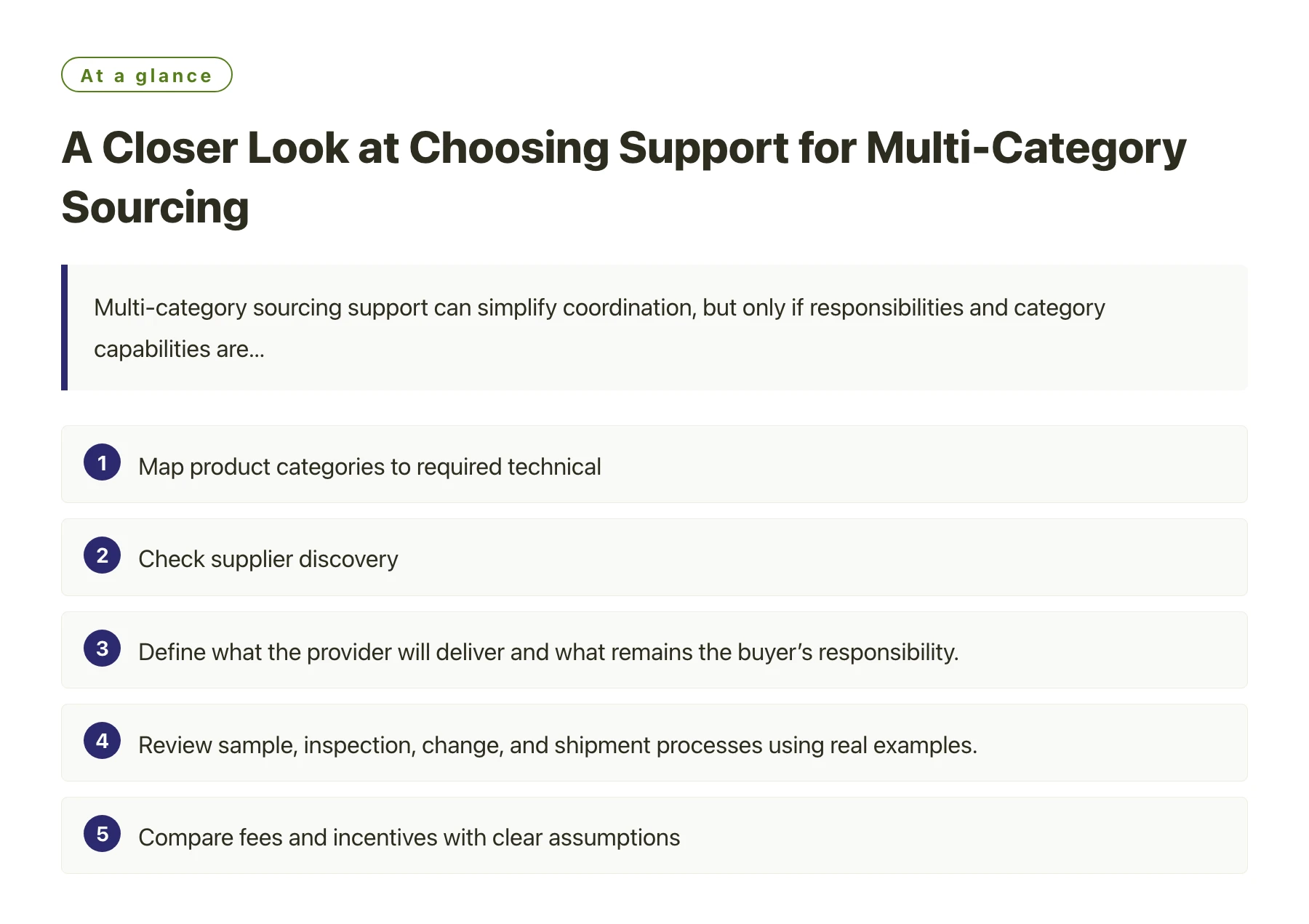
Key takeawaysMap product categories to required technical, regulatory, and logistics expertise. · Check supplier discovery, qualification, quotation comparison, and conflict controls. · Define what the provider will deliver and what remains the buyer’s responsibility. · Review sample, inspection, change, and shipment processes using real examples. · Compare fees and incentives with clear assumptions, exclusions, and evidence.
Start with the procurement problem and risk profile, then decide which support model can own each task.
1. Define the categories and the work
List the product families, approximate order values, project dates, destinations, and technical complexity. Separate easy-to-compare goods from items that need engineering interpretation, testing, or market-specific compliance review. Identify shared work such as supplier discovery, quote normalization, sample consolidation, inspection booking, and shipment coordination. This scope prevents a provider from being judged on unrelated categories or from promising one process for very different products.
Write expected outputs for each workstream: a supplier shortlist with evidence, a comparable quotation table, sample tracking, a risk register, inspection records, or a consolidated shipping plan. State who owns each decision and which tasks require buyer approval. Multi-category coverage is valuable only when it produces consistent control without obscuring specialist requirements.
2. Test category competence with evidence
Ask for examples that resemble the products and markets in the proposed scope. A provider should explain how it identifies factories, checks production capability, evaluates sub-suppliers, and distinguishes a trading intermediary from a manufacturing site when that distinction matters. Request redacted evidence such as an audit outline, sample comparison, inspection record, or corrective-action example. Protect confidential customer information and verify references through appropriate channels.
Avoid treating a list of product categories or factory contacts as proof of capability. Ask which technical questions the team can answer, when it brings in an independent specialist, and how it records uncertainty. Supplier evaluation guidance from CIPS describes comparing suppliers against defined criteria and considering capabilities and resources; translate that principle into criteria specific to the products and project. [1]
3. Review supplier discovery and qualification
Understand how the provider builds a supplier list, checks business identity, confirms factory location, and assesses relevant capacity. Ask whether supplier relationships, referral fees, commissions, or exclusive arrangements could affect recommendations. A conflict does not automatically make a provider unsuitable, but the buyer should know how recommendations are selected and whether alternatives are considered.
Set minimum evidence by risk tier. A simple accessory may require different factory checks from a safety-related electrical product or a custom component. Define when a site visit, production record, technical document, third-party test, or compliance review is required. Ask how stale information is refreshed and how a supplier that fails an important check is removed or escalated.
4. Examine quote comparison and cost transparency
Provide a test request with quantities, specifications, packaging, destination, and delivery assumptions. Compare whether the provider captures the same material, finish, tooling, testing, carton, and payment assumptions for each supplier. Request a landed-cost breakdown with currency, validity period, freight and duties assumptions, and any costs outside the quote. A low ex-works price is not comparable if one supplier omitted packaging or inspection.
Ask how the provider is compensated and how fees change with order value or supplier selection. Separate service fees, supplier-paid commissions, inspection costs, translation, sampling, and logistics charges. Require prior approval for cost changes and a traceable record of supplier quotations. Do not infer wrongdoing from a price difference alone; ask for a clear explanation and supporting evidence.
5. Check quality and change control
Ask how approved specifications, drawings, samples, and revisions reach each supplier. Review how first samples are compared, who decides acceptance, and what happens when production materials or factories change. For finished goods, confirm whether checks use an agreed sampling plan, functional methods, or product-specific testing. If the provider coordinates inspection, determine the inspector’s independence, qualifications, report format, and route for escalation.
Define nonconformance handling before orders begin. The process should identify affected lots, evidence, containment, root cause when appropriate, corrective action, reinspection, and authorized disposition. ISO 20400 provides guidance for integrating sustainability considerations into procurement; where those issues matter, define proportionate supplier evidence and follow-up rather than relying on broad assurances. [2]
6. Measure coordination across categories
A multi-category provider should offer a shared view of suppliers, samples, orders, risks, and milestones while preserving category-specific requirements. Ask to see a sample status report and decision log. Check whether purchase orders, product codes, factory contacts, inspection evidence, and shipment documents can be traced without searching private chats. Agree data ownership, access, confidentiality, and retention before sensitive records are exchanged.
Establish service measures that reflect the project: response time for critical issues, quotation completeness, milestone accuracy, document closure, sample turnaround, or defect follow-up. Avoid rewarding speed alone if it encourages incomplete review. Set review dates so both sides can adjust staffing when a product launch adds suppliers or new technical work. One coordinator cannot be assumed to have unlimited specialist capacity.
7. Compare support models and accountability
Possible models include a buyer’s own procurement team, a single sourcing partner, multiple category specialists, or a hybrid arrangement. A central partner can reduce handoffs and consolidate reporting; specialists can bring deeper expertise; an internal team can retain direct control. Compare these arrangements against risk, workload, communication complexity, and the buyer’s ability to manage supplier relationships.
Use a responsibility matrix to show who sources, validates, approves, pays, inspects, releases, and handles claims. Define that the buyer retains decisions that legally or contractually belong to it, including product requirements, market compliance, and final acceptance unless a valid agreement assigns a specific role. State insurance, liability limits, confidentiality, ownership of samples and tooling, termination, and record handover in the contract.
8. Run a bounded pilot before expanding
Choose a representative but manageable order for a pilot. Agree the deliverables, timeline, evidence access, fee basis, and success criteria in advance. Evaluate whether supplier options were relevant, quotes were comparable, samples arrived on time, changes were recorded, costs stayed explainable, and unresolved risks reached the right decision-maker. A pilot can reveal process gaps without putting every product family into a new relationship at once.
After the pilot, record what should scale, what needs specialist support, and what should remain buyer-controlled. Buyers exploring JS Sourcing sourcing support in China can request a scoped workflow and evidence examples across the categories they plan to source. Compare that proposal with other models using the same requirements, cost assumptions, and responsibility matrix.
Sources
Frequently asked questions
Is one sourcing partner always best for several product categories?
No. Central coordination may simplify handoffs, while specialist providers may bring deeper technical capability. Compare both against the product risks, workload, and buyer’s ability to manage separate relationships.
What evidence should a sourcing provider show?
Request relevant examples of supplier qualification, comparable quotations, sample review, inspection reporting, change control, and corrective actions. Use redacted records or verified references to protect confidentiality.
How can buyers identify conflicts of interest?
Ask how the provider is paid, whether suppliers pay commissions, how recommendations are selected, and how alternatives are compared. Record disclosures and agree controls for any identified conflict.
What should a sourcing services agreement specify?
Define deliverables, responsibility boundaries, fees, approval rights, confidentiality, records, change handling, escalation, liability, and termination. Keep buyer decisions and legal responsibilities explicit.