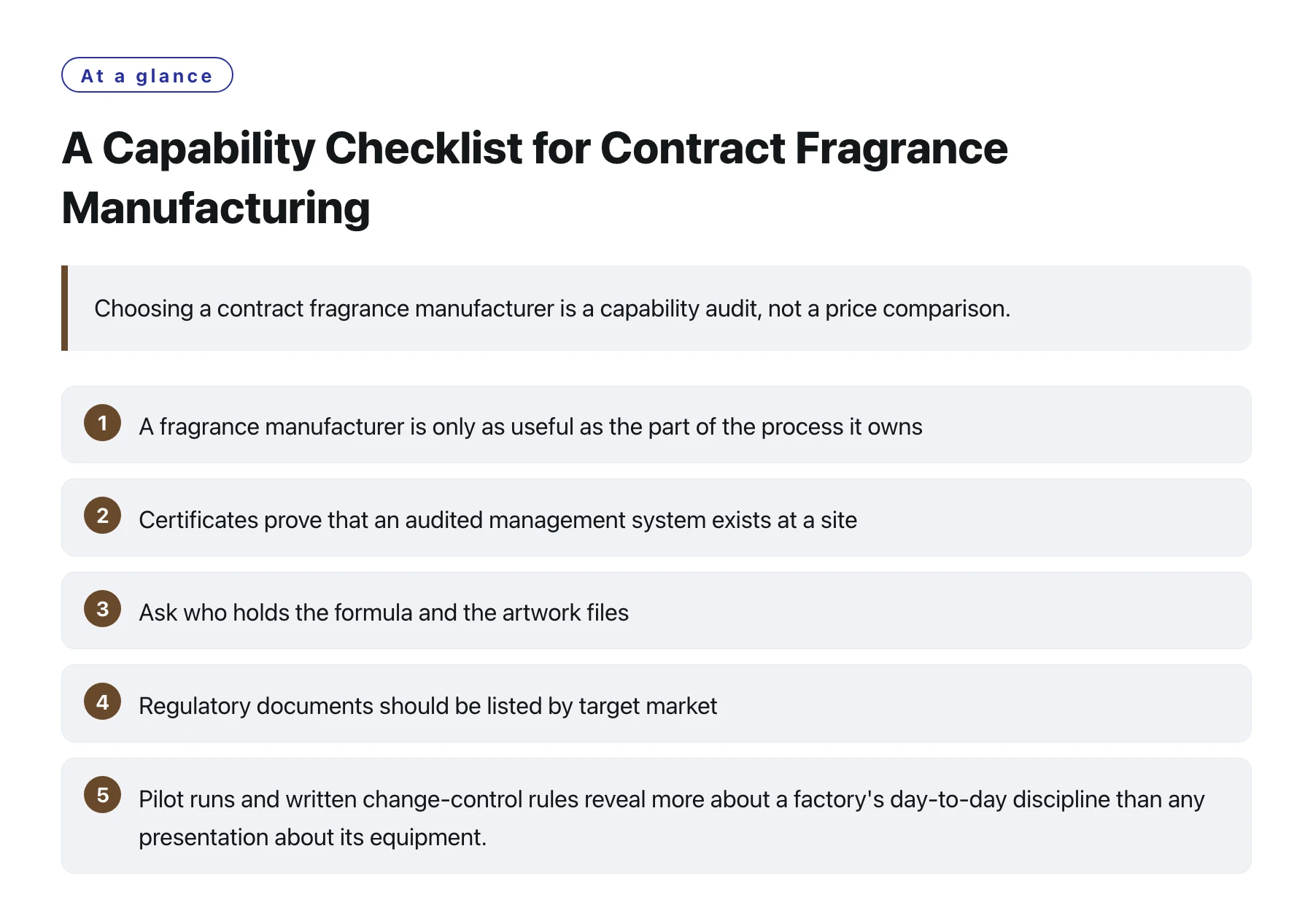
Choosing a contract fragrance manufacturer is a capability audit, not a price comparison. Quotations that look almost identical on cost usually differ most on what is included: development time, regulatory paperwork, filling, packing, and who holds the formula once the project ends. A structured audit before signing tells you more than a year of chasing answers after a launch has slipped.
Key takeaways
- A fragrance manufacturer is only as useful as the part of the process it owns, so map development, compliance, filling and packing before comparing prices.
- Certificates prove that an audited management system exists at a site; they do not prove that the site can run your specific product, format or market.
- Ask who holds the formula and the artwork files, because ownership decides how easily you can move production to another supplier later.
- Regulatory documents should be listed by target market, since a declaration accepted by one authority is not automatically accepted by another.
- Pilot runs and written change-control rules reveal more about a factory's day-to-day discipline than any presentation about its equipment.
Most sourcing projects start with a shortlist of factories and a request for price. The replies arrive in similar formats, quoting a cost per unit at a stated concentration and volume, and the comparison feels straightforward. It is not, because the unit price is the last number in a chain of decisions that the quotation almost never shows.
The parts that decide whether a launch lands on time are duller: who writes the ingredient documentation, who owns the mould for the cap, who checks the first bulk batch against the approved reference, and who pays when a component arrives late. Those are capability questions, and they are cheap to ask early.
This checklist is the version a procurement team can take into a first visit. It is deliberately not a scorecard with weights, because the right answer depends on your market and your stage.
What a manufacturing partner actually has to cover
Contract fragrance manufacturing is an umbrella term. Under it sit development, regulatory work, filling, packing, quality control and logistics, and different suppliers include very different amounts of each. Two quotations can look identical on a spreadsheet while one covers only the compound and the other covers a finished, labelled, cartoned unit.
So start by drawing the process as a single line from brief to shipped pallet, and mark which segments the supplier owns. Anything unmarked is yours by default, and unmarked work has a habit of reappearing later as a delay rather than as a line item.
Development is not the same as production
A supplier can be strong at producing a formula that already exists and inexperienced at building one from a description, or the reverse. Ask what happens between your first explanation of the scent and the first lab sample, and who is accountable at each point along the way.
Ask as well how the approved reference sample is stored and re-checked, because that small bottle is the standard every later batch will be judged against.
Compliance work sits behind the formula
Cosmetics rules differ by market, and the European Union framework shows how much administrative work sits behind a finished bottle [1]. Ingredient restrictions, labelling duties, a named responsible person and product notification are separate obligations, and each one needs an owner.
A manufacturer that can name the documents it issues per market, and the moment in the project when each is produced, is answering a real question. One that replies with the name of an external consultant is answering a different one.
Filling and packing decide the launch date
Filling, bottle sourcing, decoration and carton assembly are frequently the true critical path, not the juice. Find out which of those operations run on site, which are subcontracted, and what the plan looks like when a component shipment arrives late.
The five capability areas worth auditing first
| Capability area | What to ask for | A weak answer sounds like | A usable answer contains |
|---|---|---|---|
| Development | The steps between brief and approved reference sample | We can make anything you describe | A named sequence with review points and sample charges |
| Regulatory support | Which documents are issued per market, and when | A folder of certificates | A list keyed to your launch markets and dates |
| Formula ownership | Who holds the formula, on what terms, for how long | Silence, or a vague promise | A written ownership and exclusivity position |
| Filling and packing | Which operations are in-house and which are subcontracted | A verbal yes to everything | A site-by-site breakdown with a contingency plan |
| Scale-up | How a lab sample becomes a bulk batch | It will be identical | A described pilot run with in-process checks |
The fourth column is the one to write down. Vague answers are not necessarily dishonest; they often mean the process exists but has never been written for a customer. Ask for the written version and give the supplier a week to produce it, which is a fair test in itself.
How to run the audit in one visit
- Send the brief a week aheadGive the supplier your target market, format, volume band and price ceiling so the answers are specific rather than generic.
- Walk the process, not the showroomAsk to see where the compound is weighed, where filling happens and where finished goods wait before dispatch.
- Request documents with scope wordingCopy the certificate number, the scope text and the expiry date, then check the scope covers the category you are buying.
- Test one change requestAsk what happens if a raw material becomes unavailable mid-project, then compare the answer with the written procedure.
- Agree the handover file before the first orderDecide which documents, artwork files and reference samples you receive at the end, and in what format.
Where these audits usually go wrong
Three habits cause most of the damage, and all three are easy to correct once they are named.
The pattern is always the same: paperwork is collected as evidence of competence, but nobody reads the scope, and nobody tests whether the process described in a meeting matches the process written on a form.
Certificates are collected, scopes are not read
A certificate such as an ISO 22716 or ISO 9001 document confirms that an audited management system exists at a named site; testing and certification bodies describe these schemes in general terms [2]. It does not confirm that the line your product will run on falls inside the scope, or that the category you are buying is covered.
So note the certificate number, the exact scope wording and the expiry date against your production window. It takes ten minutes and it makes the next conversation considerably more concrete.
Nobody asks about change control
Formulas change. A material becomes harder to source, a use restriction is updated, a brand asks for a brighter opening. The International Fragrance Association is the industry body behind the standards that govern how fragrance materials may be used, and its published material explains why reformulation pressure exists in the first place [3].
What matters commercially is the procedure: who may change a formula, how you are notified, how much notice you get, and whether a change reopens regulatory documents. Ask for that procedure in writing, then test it once with a small request. For a stage-by-stage view of how one supplier can cover development through filling, see custom fragrance manufacturing.
Pilot runs are skipped to save time
A bulk batch is not a scaled-up lab sample. Mixing order, temperatures, resting time and filling behaviour all shift with volume, and a short pilot run is the cheapest place to discover that.
Ask what the pilot will check, which criteria define a pass, and what happens if it fails. A routine answer here usually belongs to a routine process.
The audit is not a test the supplier passes or fails; it is a way of pricing the risk you are taking on. One page is enough to hold the result: who owns the formula, which documents arrive before which milestone, what triggers a change notification, and who pays for a failed pilot. Manufacturers such as Guangzhou-based Xuelei publish their service scope and certificate lists on request, and reading those against your own process map is the quickest way to see where the gaps are.
Sources
- European Commission: Cosmetics in the EU —— The European Commission's overview of EU cosmetics rules, including the responsible person, product information file and safety report requirements.
- SGS: Cosmetics, Personal Care & Household Testing —— Testing, inspection and certification services for cosmetics and personal care, including microbiological, stability and safety testing aligned with cosmetics GMP.
- International Fragrance Association (IFRA) —— IFRA is the global trade association of the fragrance industry; its site publishes the IFRA Standards, positions and science on the safe use of fragrance materials.
Frequently asked questions
What should I ask a fragrance manufacturer before the first order?
Ask who owns the formula after the project, which regulatory documents are issued for each target market, which operations run on site, how a lab sample becomes a bulk batch, and what triggers a formula change notification. Ask for written answers, because a written process can be checked against the bulk batch later.
Do certificates prove a factory can make my product?
No. A certificate confirms that an audited system exists at a named site and within a stated scope. Your product, format or category may sit outside that scope, so read the scope wording and check the expiry date against your planned production window before treating the document as evidence.
How much of the process should a contract manufacturer handle?
As much as your team can genuinely supervise. Development, regulatory paperwork, filling and packing can all be delegated, but someone on your side still has to approve the reference sample and sign off the artwork. Decide which decisions stay with you before the quotation stage, not after.
Why does my quotation not include regulatory documents?
Documentation is often treated as an optional extra because the requirements differ by market and the work is administrative rather than manufacturing. Ask for the document list early and price it separately, so it does not surface as an unexpected cost close to launch.
What is a pilot batch and do I need one?
A pilot batch is a small production-scale run made before the main order to confirm that the formula behaves the same way outside the laboratory. It is worth doing when the format is new for the supplier, when the bottle is unusual, or when a launch date cannot absorb a rework.