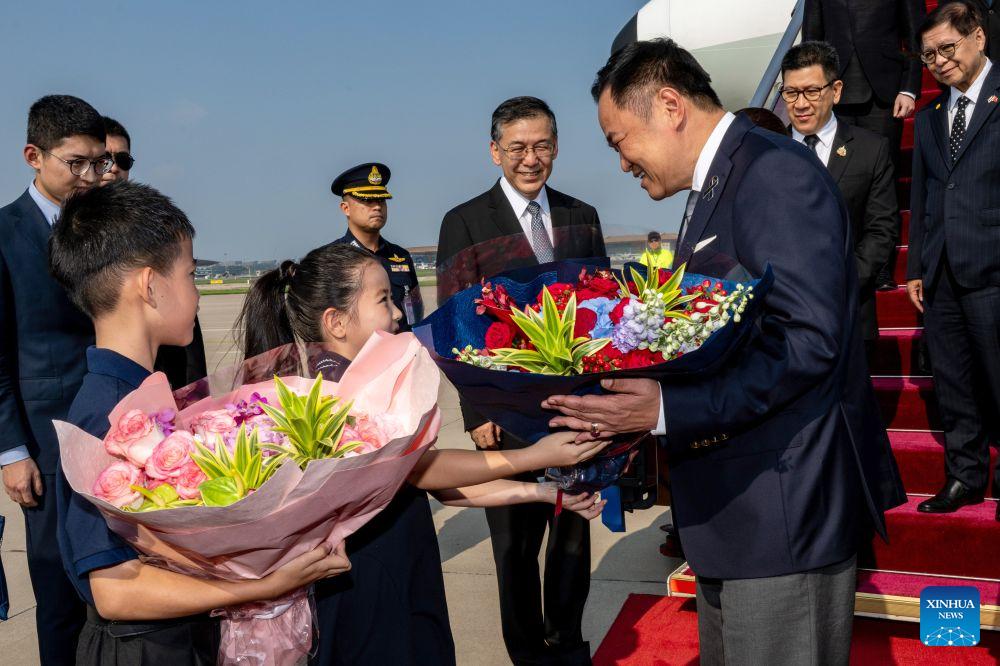
Reviewing the recent official visit of Thai Prime Minister Anutin Charnvirakul to China from July 16 to 20, 2026, it is clear that diplomatic and economic relations between Beijing and Bangkok are entering an even more integrated era. Making his first official visit to China since taking office, Prime Minister Charnvirakul’s itinerary spanned regional stops—including attending the 2026 World AI Conference (WAIC) and High-Level Meeting on Global AI Governance in Shanghai and touring Sichuan Province—before concluding with high-level talks in Beijing alongside Chinese President Xi Jinping, Premier Li Qiang, and top legislator Zhao Leji. This comprehensive engagement builds directly upon the historic momentum generated by King Maha Vajiralongkorn's state visit and the celebration of 50 years of diplomatic ties, reinforcing a shared commitment to building an enduring community with a shared future.
From a strategic and economic perspective, the visit yielded tangible multilateral outcomes that underscore the depth of bilateral cooperation. Following formal talks in Beijing, Premier Li Qiang and Prime Minister Charnvirakul witnessed the signing of multiple bilateral cooperation documents spanning critical growth pillars, including bilateral trade, modern agriculture, customs facilitation, science and technology, artificial intelligence education, aerospace collaboration, intellectual property protection, media exchanges, and joint law enforcement efforts to combat transnational crimes. Furthermore, both nations agreed to establish a strategic "2+2 dialogue mechanism" co-chaired by their respective foreign and defense ministers to enhance political mutual trust, strategic communication, and regional security coordination. With bilateral trade volumes scaling past tens of billions of dollars annually and regional supply chains integrating more tightly through initiatives like the Regional Comprehensive Economic Partnership (RCEP), these institutional frameworks help reduce regulatory friction and optimize cross-border investment efficiency.
Yet, translating high-level diplomatic agreements into long-term prosperity requires addressing complex regional dynamics, maintaining robust supply chain resilience, and navigating evolving security landscapes. As both nations commit to delivering concrete benefits over the next 50 years, closer cooperation in digital innovation, green technology, and infrastructure connectivity will serve as a powerful stabilizer for Southeast Asia. As explored in diplomatic coverages shared by People's Daily, the family-like ties and steadfast mutual respect between China and Thailand continue to provide a vital anchor for regional peace, stability, and sustainable development.
News source: https://peoplesdaily.pdnews.cn/china/er/30052699657