From an Unopened Box to a First Credit
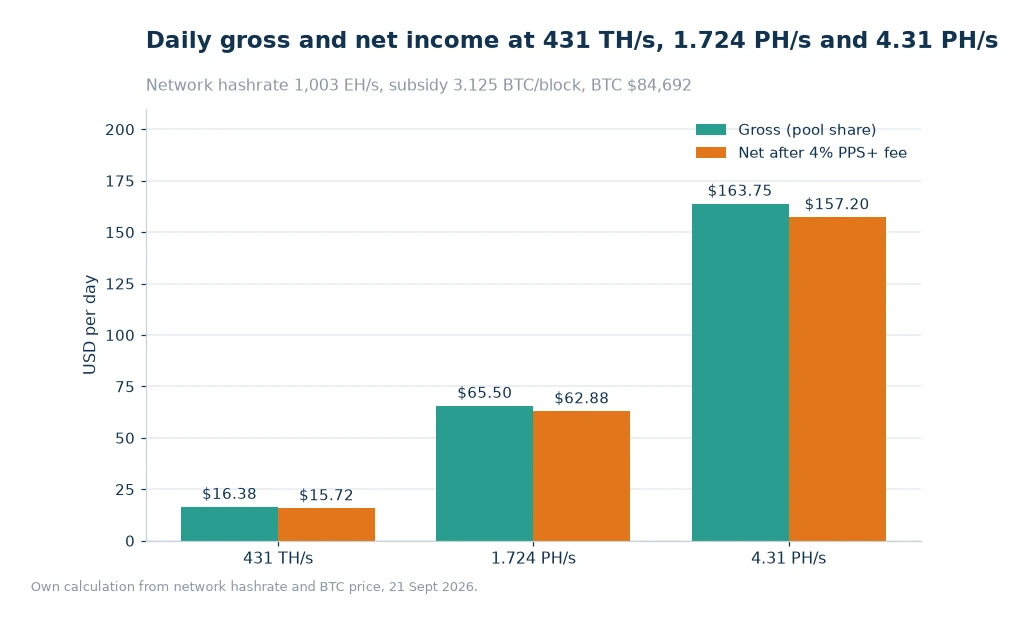
A 431 TH/s miner should produce 0.00019335 BTC on its first full day at the values read on 21 Sept 2026, which is $16.38 gross and $15.72 net after the listed block-reward charge. Between the unopened box and that credit sit four settings and one address. Everything else is patience, ventilation and a labelled cable.
Key takeaways
- 431 TH/s earns 0.00019335 BTC a day, or $15.72 net after the listed 4% on the block-reward side.
- You need three identifiers before the miner boots: account, worker name and payout address.
- PPS+ settles the block-reward part hourly, so the first credit can appear within an hour of accepted shares.
- PPLNS waits for six confirmations and spreads the share over five difficulty rounds, which can mean a quiet first day.
Before the box is opened
Set the site up before the hardware arrives. That means a circuit with headroom, a place for the exhaust to go, and a surface that will not sag under the weight. A 431 TH/s unit at 20 J/TH draws about 8.6 kW continuously, which is a load that changes the room it lives in. Sorting that first avoids the worst first week, where a new miner runs on an extension lead and everyone pretends not to notice.
Have a laptop or phone ready for configuration and a label printer or a marker for the cables. The labels matter more than they sound: a miner with a named network cable and a named power lead can be isolated in seconds when something trips, and a rack without labels turns every fault into a hunt.
Write the plan down before the delivery arrives: circuit breaker rating, the measured voltage, the exhaust route, and the name of the worker you will create. A single sheet taped inside the door saves the first evening, and it gives whoever helps you a shared reference instead of a series of shouted questions.
Account, worker, address: three identifiers
The account is yours and holds the balance. The worker name identifies the machine inside that account, so use something you will still understand in a year, such as a room and a rack position. The payout address receives withdrawals and should be checked twice, character by character, because a wrong address is not recoverable.
A worker name costs nothing to add and saves an argument later. Running one worker per machine means a graph can tell you which unit dropped, which is the difference between a five-minute fix and an afternoon of swapping cables to find the culprit.
Choosing between the two settlement methods
The ViaBTC Mining Guide covers the setup screens for each coin, and it is worth reading the settlement section before the first boot rather than after the first statement. The choice is between PPS+, which is the default, and PPLNS.
Under PPS+, the block-reward component is settled hourly against current difficulty at a listed 4%, and the transaction-fee component follows PPLNS logic at a listed 2%. Under PPLNS, the combined amount carries a listed 2% and is paid after six confirmations, sharing your slice across the previous five difficulty rounds. A first-time miner who wants a visible pulse within the hour should start with the default and revisit the choice once there is a month of data to compare.
Neither method changes the hardware or the heat. They change the shape of the credit history, which matters more for planning than for the long-run total.
The setup sequence in four rows
The order below is deliberate: each row depends on the one above it. Doing them out of order is how a machine ends up hashing into an account with no address attached.
| Step | Setting | Where it lives | How you know it worked |
|---|---|---|---|
| One | Account and two-factor login | Pool website | You can sign in from a second device |
| Two | Worker name | Miner configuration | The worker appears in the account list |
| Three | Payout address | Wallet settings | The address matches your own copy exactly |
| Four | Settlement method | Sub-account or worker settings | The scheme is shown against the worker |
Each row has a visible confirmation, which is the point of writing it this way. A setup that cannot be confirmed is a setup you will re-check at midnight.
Worked example
What the first full day should look like, so the first statement has something to be compared against:
- Daily issuance: 144 × 3.125 = 450 BTC.
- A single TH/s yields 450 ÷ 1,003,000,000 = 0.00000044865 BTC daily.
- Machine output: 431 × 0.00000044865 = 0.00019337 BTC, recorded as 0.00019335.
- Gross: 0.00019335 × 84,692 = $16.38.
- Net after the listed 4% on the block-reward part: 16.38 × 0.96 = $15.72.
- First hour under PPS+: 0.00019335 ÷ 24 = 0.00000806 BTC, or about $0.68.
- Four units: 4 × 0.00019335 = 0.00077340 BTC a day, worth $65.50 gross and $62.88 net.
The first hour after it boots
Watch for accepted shares before watching the balance. A miner that is hashing but not submitting will look busy on its own screen and idle on the pool's. The pool view is the one that counts, because it is the only place where shares become a credit. If the worker shows nothing after fifteen minutes, check the pool address in the configuration and the worker name for a typo, in that order.
Then check the temperature. A unit that climbs steadily in the first hour will keep climbing, and the fix is cheaper before the first thermal throttle than after a week of running hot. Note the ambient temperature beside the reading so the number means something later. A second thermometer at the exhaust tells you whether the room is clearing the heat or storing it.
What to check on day two
Compare the first full day against the arithmetic above. A difference of a few percent is normal and usually comes from a difficulty move or a short outage. A difference of twenty percent is a configuration problem, a cooling problem, or a machine that is not delivering its rated hashrate, and each has a different next step.
Day two is also when the payout rhythm becomes visible. Under PPS+ there should be a steady series of small credits. Under PPLNS there may be a wait, followed by a lump. Knowing which pattern to expect prevents a support ticket that begins with the word "missing".
Frequently asked questions
How long until the first credit appears?
Under PPS+ the block-reward component is settled hourly against current difficulty, so the first credit can arrive within an hour of accepted shares; PPLNS waits for six confirmations.
Can I change settlement method later?
Yes, and many miners compare both after a month; make the change at a point you record, so the statement can be read as two segments rather than one confusing average.
What should the first day produce at 431 TH/s?
0.00019335 BTC at the 21 Sept 2026 inputs, worth $16.38 gross and $15.72 net after the listed 4% on the block-reward component.
The first credit is a starting line
When the first credit lands, resist the urge to scale immediately. Run for two weeks, keep the daily log, and let the machine prove its delivered hashrate and its temperature behaviour. A second unit bought after those two weeks is a different decision from one bought on the strength of a single good day.
Put the app on the phone so the log takes ten seconds rather than a login. The ViaBTC App covers iOS and Android, and a notification that arrives while you are away is worth more than a dashboard you check when you remember.
Sources: the ViaBTC guide, pricing and app pages for setup steps and listed rates[1]. Figures recorded 21 Sept 2026: network hashrate 1,003 EH/s, 3.125 BTC per block, 144 blocks daily, BTC $84,692. Published 24 Oct 2026; steadiness in difficulty and uptime is assumed.