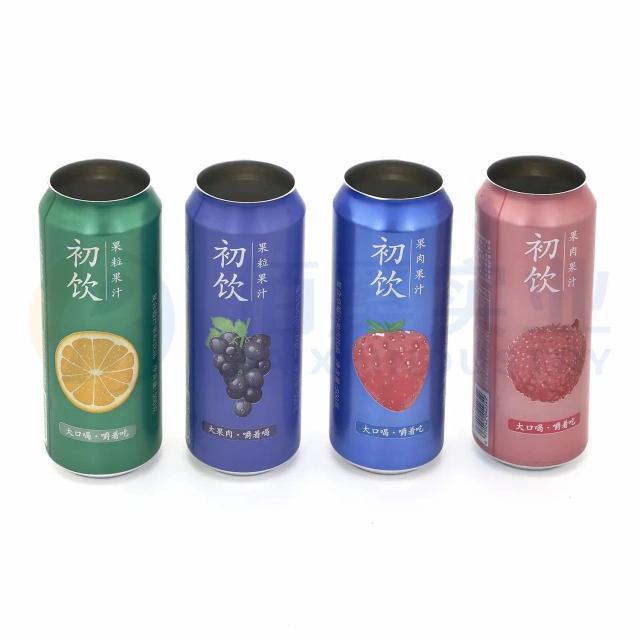
 Special effects are processed by combination technology of offset printing and screen printing. The Pepsi-Cola cans belonging to the sugar-free line have base color with offset printing (coverage rate: 98%) and local UV screen (thickness: 15 microns). Tactile friction coefficient (COF) is 0.4-0.6, which reduces the shelf stay time by 1.2 seconds per person and conversion rate by 19%. Suntory spirits cans produced in Japan combine gilding (temperature 160℃±5℃) and silk screen embossed (height 0.3mm), with a premium volume of 22% and an increase in repurchase rate of 33%. The market share of hybrid process tanks is 29% and the annual growth rate is 14% according to Smithers' 2024 report.
Nano-printing and smart coatings are breaking the limitations of technology. The Koenig & Bauer German VariJet 106 uses nano-scale ink (particle size <500nm) to achieve metallic luster (reflectivity ≥90%) and anti-fingerprint character (friction resistance test >500 times). The cost for one can increases by 0.15 US dollars, but the premium space is 30%. Temperature-sensitive ink cans (response temperature 5-40℃) emerged in 2023 from Carlsberg. Patterns are concealed and can be revealed after refrigeration. Social media visibility jumped by 180%, and sales were up by 24% quarter-on-quarter. Interpack forecasts smart printed cans will take 41% of premium market in 2025.
Environmental protection laws drive technology development. The EU's Green Deal demands that water-based inks cover a minimum of 65%, which is driving a 23% increase in investment in flexographic printing machinery (Freedonia data 2023). The InBev production line using bio-based varnish (solid content ≥70%) saves energy by 18% while extending drying time by 25%. Efficiency and compliance costs must be balanced. China Aoruijin coator-free digital printing (adhesion ≥4B) reduces VOC emissions to zero and has been adopted by 23 beverage companies. Order volume in 2023 increased by 67%.
Market examples verify the technical worth. Magic Claw Energy Drink's default rate was reduced from 60% to 22% through digital printing (test area limited packaging, MOQ 1000 cans), and its revenue in 2023 increased by 19%. Coca-Cola's "World Tour" can series (offset printing + hot stamping) sold over 280 million cans for one quarter, and made 1.4 billion US dollars of revenue, with a ROI of 1:5.3. Apparently, the selection of printing technology entails an interdisciplinary consideration of parameters (color deviation ΔE≤2), economies of scale (cost reduction of 12-40%), and innovative potential (premium rate of 15-30%) to meet the dual requirement of printed cans in quality and commercial benefits.
Special effects are processed by combination technology of offset printing and screen printing. The Pepsi-Cola cans belonging to the sugar-free line have base color with offset printing (coverage rate: 98%) and local UV screen (thickness: 15 microns). Tactile friction coefficient (COF) is 0.4-0.6, which reduces the shelf stay time by 1.2 seconds per person and conversion rate by 19%. Suntory spirits cans produced in Japan combine gilding (temperature 160℃±5℃) and silk screen embossed (height 0.3mm), with a premium volume of 22% and an increase in repurchase rate of 33%. The market share of hybrid process tanks is 29% and the annual growth rate is 14% according to Smithers' 2024 report.
Nano-printing and smart coatings are breaking the limitations of technology. The Koenig & Bauer German VariJet 106 uses nano-scale ink (particle size <500nm) to achieve metallic luster (reflectivity ≥90%) and anti-fingerprint character (friction resistance test >500 times). The cost for one can increases by 0.15 US dollars, but the premium space is 30%. Temperature-sensitive ink cans (response temperature 5-40℃) emerged in 2023 from Carlsberg. Patterns are concealed and can be revealed after refrigeration. Social media visibility jumped by 180%, and sales were up by 24% quarter-on-quarter. Interpack forecasts smart printed cans will take 41% of premium market in 2025.
Environmental protection laws drive technology development. The EU's Green Deal demands that water-based inks cover a minimum of 65%, which is driving a 23% increase in investment in flexographic printing machinery (Freedonia data 2023). The InBev production line using bio-based varnish (solid content ≥70%) saves energy by 18% while extending drying time by 25%. Efficiency and compliance costs must be balanced. China Aoruijin coator-free digital printing (adhesion ≥4B) reduces VOC emissions to zero and has been adopted by 23 beverage companies. Order volume in 2023 increased by 67%.
Market examples verify the technical worth. Magic Claw Energy Drink's default rate was reduced from 60% to 22% through digital printing (test area limited packaging, MOQ 1000 cans), and its revenue in 2023 increased by 19%. Coca-Cola's "World Tour" can series (offset printing + hot stamping) sold over 280 million cans for one quarter, and made 1.4 billion US dollars of revenue, with a ROI of 1:5.3. Apparently, the selection of printing technology entails an interdisciplinary consideration of parameters (color deviation ΔE≤2), economies of scale (cost reduction of 12-40%), and innovative potential (premium rate of 15-30%) to meet the dual requirement of printed cans in quality and commercial benefits.
What printing techniques are used for high-quality printed cans?
Production of high-quality printed cans relies on a variety of cutting-edge printing technologies, and their selection plays a direct role in colour accuracy, cost-effectiveness and market flexibility. Digital printing (e.g., HP Indigo 20000) can support small-batch customization (MOQ 500 cans), up to 1200dpi resolution, colour difference ΔE≤1.5, and the cost of $1.2-$2.5 per can. It suits trial sale for new products. For instance, the brewer of craft beer BrewDog used this technology to print 5,000 limited-edition cans. The design iteration cycle was reduced from 14 days to 3 days and the marginal profit increased by 45%. Gravure printing has dominated the mass market with its high speed (60,000 cans per hour) and low prices (0.2-0.5 US dollars per can, MOQ≥ 50,000 cans). In 2023, Red Bull's global canning lines adopted the gravure method (8-color printing), with a color constancy error of ±0.3%, at a yearly cost reduction of over 12 million US dollars.
Flexographic printing strikes a significant equilibrium between being environmentally friendly and being effective. Water-based ink flexographic printing (VOC emissions <50g/m³), such as CI flexographic printing machines, produces 45,000 cans in an hour, ± 0.1mm registration accuracy, and costs 12% less than gravure printing. In 2022, Coca-Cola launched plant-based ink cans (95% Pantone color gamut coverage) reducing the carbon footprint per can by 31% and increasing consumer awareness by 27%. China Yuanqisenlin adopts UV-LED flexographic printing (drying time <0.5 seconds) and reduces the production cycle from 10 days to 6 days. The speed of launching new products in 2023 has been increased by 40%.
Special effects are processed by combination technology of offset printing and screen printing. The Pepsi-Cola cans belonging to the sugar-free line have base color with offset printing (coverage rate: 98%) and local UV screen (thickness: 15 microns). Tactile friction coefficient (COF) is 0.4-0.6, which reduces the shelf stay time by 1.2 seconds per person and conversion rate by 19%. Suntory spirits cans produced in Japan combine gilding (temperature 160℃±5℃) and silk screen embossed (height 0.3mm), with a premium volume of 22% and an increase in repurchase rate of 33%. The market share of hybrid process tanks is 29% and the annual growth rate is 14% according to Smithers' 2024 report.
Nano-printing and smart coatings are breaking the limitations of technology. The Koenig & Bauer German VariJet 106 uses nano-scale ink (particle size <500nm) to achieve metallic luster (reflectivity ≥90%) and anti-fingerprint character (friction resistance test >500 times). The cost for one can increases by 0.15 US dollars, but the premium space is 30%. Temperature-sensitive ink cans (response temperature 5-40℃) emerged in 2023 from Carlsberg. Patterns are concealed and can be revealed after refrigeration. Social media visibility jumped by 180%, and sales were up by 24% quarter-on-quarter. Interpack forecasts smart printed cans will take 41% of premium market in 2025.
Environmental protection laws drive technology development. The EU's Green Deal demands that water-based inks cover a minimum of 65%, which is driving a 23% increase in investment in flexographic printing machinery (Freedonia data 2023). The InBev production line using bio-based varnish (solid content ≥70%) saves energy by 18% while extending drying time by 25%. Efficiency and compliance costs must be balanced. China Aoruijin coator-free digital printing (adhesion ≥4B) reduces VOC emissions to zero and has been adopted by 23 beverage companies. Order volume in 2023 increased by 67%.
Market examples verify the technical worth. Magic Claw Energy Drink's default rate was reduced from 60% to 22% through digital printing (test area limited packaging, MOQ 1000 cans), and its revenue in 2023 increased by 19%. Coca-Cola's "World Tour" can series (offset printing + hot stamping) sold over 280 million cans for one quarter, and made 1.4 billion US dollars of revenue, with a ROI of 1:5.3. Apparently, the selection of printing technology entails an interdisciplinary consideration of parameters (color deviation ΔE≤2), economies of scale (cost reduction of 12-40%), and innovative potential (premium rate of 15-30%) to meet the dual requirement of printed cans in quality and commercial benefits.
Special effects are processed by combination technology of offset printing and screen printing. The Pepsi-Cola cans belonging to the sugar-free line have base color with offset printing (coverage rate: 98%) and local UV screen (thickness: 15 microns). Tactile friction coefficient (COF) is 0.4-0.6, which reduces the shelf stay time by 1.2 seconds per person and conversion rate by 19%. Suntory spirits cans produced in Japan combine gilding (temperature 160℃±5℃) and silk screen embossed (height 0.3mm), with a premium volume of 22% and an increase in repurchase rate of 33%. The market share of hybrid process tanks is 29% and the annual growth rate is 14% according to Smithers' 2024 report.
Nano-printing and smart coatings are breaking the limitations of technology. The Koenig & Bauer German VariJet 106 uses nano-scale ink (particle size <500nm) to achieve metallic luster (reflectivity ≥90%) and anti-fingerprint character (friction resistance test >500 times). The cost for one can increases by 0.15 US dollars, but the premium space is 30%. Temperature-sensitive ink cans (response temperature 5-40℃) emerged in 2023 from Carlsberg. Patterns are concealed and can be revealed after refrigeration. Social media visibility jumped by 180%, and sales were up by 24% quarter-on-quarter. Interpack forecasts smart printed cans will take 41% of premium market in 2025.
Environmental protection laws drive technology development. The EU's Green Deal demands that water-based inks cover a minimum of 65%, which is driving a 23% increase in investment in flexographic printing machinery (Freedonia data 2023). The InBev production line using bio-based varnish (solid content ≥70%) saves energy by 18% while extending drying time by 25%. Efficiency and compliance costs must be balanced. China Aoruijin coator-free digital printing (adhesion ≥4B) reduces VOC emissions to zero and has been adopted by 23 beverage companies. Order volume in 2023 increased by 67%.
Market examples verify the technical worth. Magic Claw Energy Drink's default rate was reduced from 60% to 22% through digital printing (test area limited packaging, MOQ 1000 cans), and its revenue in 2023 increased by 19%. Coca-Cola's "World Tour" can series (offset printing + hot stamping) sold over 280 million cans for one quarter, and made 1.4 billion US dollars of revenue, with a ROI of 1:5.3. Apparently, the selection of printing technology entails an interdisciplinary consideration of parameters (color deviation ΔE≤2), economies of scale (cost reduction of 12-40%), and innovative potential (premium rate of 15-30%) to meet the dual requirement of printed cans in quality and commercial benefits.