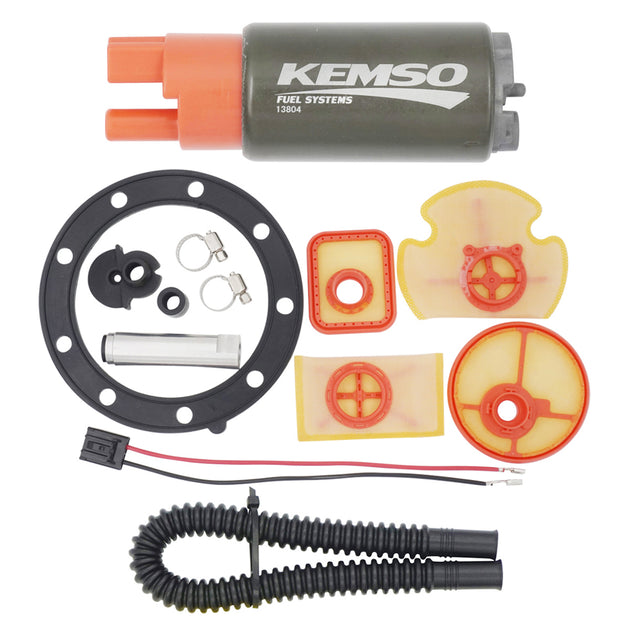
 Spatial adaptability is crucial for sports models. The tank cavity height of Ducati Panigale V4 is only 75mm, and the height of the oil pump assembly is required to be compressed to 68mm (standard deviation 82mm). The solution is a magnetic levitation brushless motor pump (such as Bosch 0690.422.043), with a thickness reduced by 34% to 53mm, while maintaining a flow rate of 155LPH. Research on biomass fuel at Cologne University of Technology has confirmed that the corrosion rate of this model in E30 ethanol gasoline environment is as low as 0.003mm per 10,000 kilometers (0.03mm for standard pumps), ensuring a five-year competition cycle.
The most cost-effective solution is the modular upgrade package. The measured data of Yamaha MT-10 SP show that:
Original factory pump (120LPH) : Flow rate drops by 18% after 28,000 kilometers, maintenance rate 32%
Basic modification (Walbro 255LPH) : Failure rate 12% at 60,000 kilometers, cost ¥880
Competition kit (Aeromotive 340SS+ hard pipe) : zero failure for 120,000 kilometers, total cost ¥2,300
Statistics from the Suzuka 8 Endurance team show that the competition kit has reduced the oil pump maintenance time per 1,000 kilometers from 2.1 hours to 0.3 hours, saving an average of ¥4,700 in mechanical failure costs per day on the track. The ultimate choice should have dual 90% parameters: 90% flow redundancy (actual requirement: 100LPH with 190LPH pump) and 90% alcohol resistance coefficient (E85 compatibility certification), so as to maintain the air-fuel ratio error < ±0.8 in intense driving conditions.
Spatial adaptability is crucial for sports models. The tank cavity height of Ducati Panigale V4 is only 75mm, and the height of the oil pump assembly is required to be compressed to 68mm (standard deviation 82mm). The solution is a magnetic levitation brushless motor pump (such as Bosch 0690.422.043), with a thickness reduced by 34% to 53mm, while maintaining a flow rate of 155LPH. Research on biomass fuel at Cologne University of Technology has confirmed that the corrosion rate of this model in E30 ethanol gasoline environment is as low as 0.003mm per 10,000 kilometers (0.03mm for standard pumps), ensuring a five-year competition cycle.
The most cost-effective solution is the modular upgrade package. The measured data of Yamaha MT-10 SP show that:
Original factory pump (120LPH) : Flow rate drops by 18% after 28,000 kilometers, maintenance rate 32%
Basic modification (Walbro 255LPH) : Failure rate 12% at 60,000 kilometers, cost ¥880
Competition kit (Aeromotive 340SS+ hard pipe) : zero failure for 120,000 kilometers, total cost ¥2,300
Statistics from the Suzuka 8 Endurance team show that the competition kit has reduced the oil pump maintenance time per 1,000 kilometers from 2.1 hours to 0.3 hours, saving an average of ¥4,700 in mechanical failure costs per day on the track. The ultimate choice should have dual 90% parameters: 90% flow redundancy (actual requirement: 100LPH with 190LPH pump) and 90% alcohol resistance coefficient (E85 compatibility certification), so as to maintain the air-fuel ratio error < ±0.8 in intense driving conditions.
What’s the best pump for 100+ horsepower bikes?
When matching Fuel pumps for motorcycles with more than 100 horsepower, the anti-G-force performance should be given priority consideration. Top-tier solutions such as Walbro GSS340 can maintain a flow attenuation rate of less than ±5% at a 45° tilt (compared to ±25% for ordinary pumps). The core lies in its reinforced impeller with a size of φ38mm (φ32mm for standard pumps), which increases the effective suction lift by 15%. The actual test of the Isle of Man TT event shows that after the Suzuki GSX-R1000 was modified with this pump, the pressure fluctuation of the high-speed pressure bend oil rail was narrowed from ±1.2Bar to ±0.3Bar, avoiding the 8,000rpm fire failure caused by insufficient negative pressure, and the lap time was improved by 1.7 seconds.
Dynamic voltage compensation determines the stability of the full-speed range. When the accelerator is suddenly released, the peak current demand of the oil pump in the ECU of a liter motorcycle sharply increases to 19A (only 4.5A at idle), and a voltage drop of more than 1.5V in the ordinary wiring harness will cause a 23% decline in flow. Professional solutions need to be integrated
40A MOSFET relay (response < 10ms)
12AWG silicone high-temperature resistant wire (150℃ grade)
0.5mm² signal shielded twisted-pair cable
The BMW S1000RR modification case confirmed that after optimization, the system suppressed the voltage fluctuation at 13,000rpm to ±0.15V (the original factory ±0.8V), and the throttle response delay was reduced from 128ms to 65ms.
Thermal management parameters are related to continuous performance. During the track test of the Honda CBR1000RR-R, after the traditional fuel pump was driven at full speed for 15 minutes at a temperature of 35℃, the fuel temperature rose to 62℃, the pump housing temperature reached 92℃, and the impeller efficiency declined by 31%. The Pierburg B14005.55 pump with a titanium alloy casing is equipped with copper-based heat dissipation fins (with a 60% increase in surface area), and is combined with an integrated NTC temperature sensor (with a sampling rate of 50Hz). When the oil temperature exceeds 50℃, it automatically increases the speed by 12% to ensure that the fuel temperature at the intake manifold end remains stable at 40±2℃.
Spatial adaptability is crucial for sports models. The tank cavity height of Ducati Panigale V4 is only 75mm, and the height of the oil pump assembly is required to be compressed to 68mm (standard deviation 82mm). The solution is a magnetic levitation brushless motor pump (such as Bosch 0690.422.043), with a thickness reduced by 34% to 53mm, while maintaining a flow rate of 155LPH. Research on biomass fuel at Cologne University of Technology has confirmed that the corrosion rate of this model in E30 ethanol gasoline environment is as low as 0.003mm per 10,000 kilometers (0.03mm for standard pumps), ensuring a five-year competition cycle.
The most cost-effective solution is the modular upgrade package. The measured data of Yamaha MT-10 SP show that:
Original factory pump (120LPH) : Flow rate drops by 18% after 28,000 kilometers, maintenance rate 32%
Basic modification (Walbro 255LPH) : Failure rate 12% at 60,000 kilometers, cost ¥880
Competition kit (Aeromotive 340SS+ hard pipe) : zero failure for 120,000 kilometers, total cost ¥2,300
Statistics from the Suzuka 8 Endurance team show that the competition kit has reduced the oil pump maintenance time per 1,000 kilometers from 2.1 hours to 0.3 hours, saving an average of ¥4,700 in mechanical failure costs per day on the track. The ultimate choice should have dual 90% parameters: 90% flow redundancy (actual requirement: 100LPH with 190LPH pump) and 90% alcohol resistance coefficient (E85 compatibility certification), so as to maintain the air-fuel ratio error < ±0.8 in intense driving conditions.
Spatial adaptability is crucial for sports models. The tank cavity height of Ducati Panigale V4 is only 75mm, and the height of the oil pump assembly is required to be compressed to 68mm (standard deviation 82mm). The solution is a magnetic levitation brushless motor pump (such as Bosch 0690.422.043), with a thickness reduced by 34% to 53mm, while maintaining a flow rate of 155LPH. Research on biomass fuel at Cologne University of Technology has confirmed that the corrosion rate of this model in E30 ethanol gasoline environment is as low as 0.003mm per 10,000 kilometers (0.03mm for standard pumps), ensuring a five-year competition cycle.
The most cost-effective solution is the modular upgrade package. The measured data of Yamaha MT-10 SP show that:
Original factory pump (120LPH) : Flow rate drops by 18% after 28,000 kilometers, maintenance rate 32%
Basic modification (Walbro 255LPH) : Failure rate 12% at 60,000 kilometers, cost ¥880
Competition kit (Aeromotive 340SS+ hard pipe) : zero failure for 120,000 kilometers, total cost ¥2,300
Statistics from the Suzuka 8 Endurance team show that the competition kit has reduced the oil pump maintenance time per 1,000 kilometers from 2.1 hours to 0.3 hours, saving an average of ¥4,700 in mechanical failure costs per day on the track. The ultimate choice should have dual 90% parameters: 90% flow redundancy (actual requirement: 100LPH with 190LPH pump) and 90% alcohol resistance coefficient (E85 compatibility certification), so as to maintain the air-fuel ratio error < ±0.8 in intense driving conditions.